
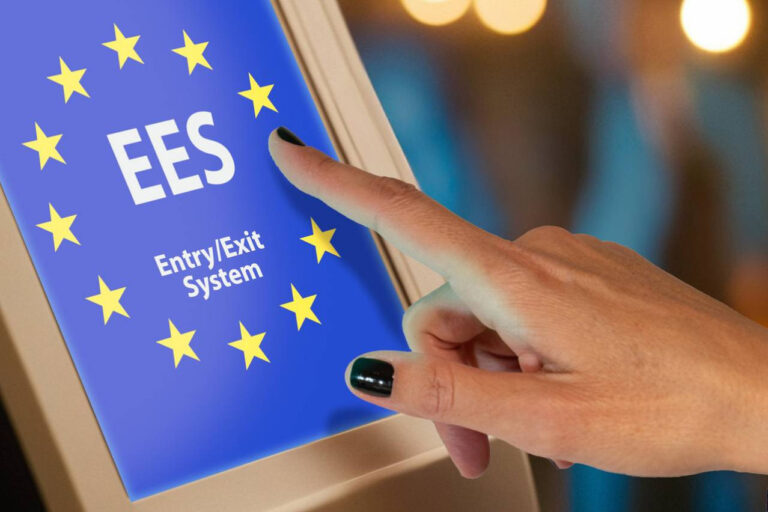
On 12 October, the European Union will bring into service its automated Entry/Exit System (EES) at the Schengen area’s external borders. For non-European nationals, this will mean the collection of biometric data (fingerprints, photo), the gradual disappearance of stamps, and stricter monitoring of stays.
From 12 October 2025, the new Entry/Exit System (EES) will come into operation, marking a turning point in the management of the Schengen countries’ external borders. This system will gradually replace the stamp in passports for travellers from third countries (non-EU/Schengen) by electronically recording entry and exit. Implementation will be gradual, with a transitional period until 10 April 2026, when the mechanism must be fully operational in all participating states.
During this phase, some border posts will already be applying the system while others will continue to stamp passports, to ensure a smooth transition.
What changes for non-EU travellers
– Biometric collection + removal of stamps: On first entry after launch, passengers will be required to provide fingerprints and a facial image to be enrolled in the system. Subsequent entries/exits can be verified by cross-referencing the photo/scan with the data already stored. The system will also automatically record the place, date and time of entry and exit. Eventually, physical stamps in passports will be eliminated for these categories of travellers.
– Retention period, monitoring of overruns: data will be kept for three years after exit, or even five years if no exit is recorded. The EES will make it possible to automatically detect travellers who exceed the 90 days authorised within a 180-day period, and to facilitate checks by the national authorities.
– Impacts on time at borders: biometric enrolment can take a few extra minutes, especially at first. Some operators, such as Eurotunnel, assure that delays will be limited (for example, a maximum of two extra minutes) due to the investment in biometric kiosks. In exceptional cases, in the event of malfunctions or excessive congestion, the authorities may temporarily revert to the old buffer mode.
What’s next?
Once mature, the system could speed up border crossings through automation and biometric recognition.
In parallel, the launch of Etias, scheduled for the end of 2026, will complement this system with an electronic travel authorisation for visa-exempt visitors.
If you have any questions or need more information, you can visit the official European Union website, where you will find frequently asked questions and exceptions to which the EES does not apply.
Our Commitment to You
At El Accesso, we are committed to making your travel experience exceptional. Our team is passionate about travel and dedicated to providing you with the highest level of service. We understand the importance of creating memories that last a lifetime, and we strive to exceed your expectations at every turn.
Get Start Today!
Are you ready to embark on a unique adventure tailored just for you? Contact us today to start planning your customized tour with El Accesso Travels and Tours Limited!
- Email: info@elaccessotravels.com, bookings@elaccessotravels.com
- Phone: +2348165979826 +2349012345888